

Trump weighs sending second plane service to Middle East in midst of tense Iran talks
President Donald Trump has indicated he’s considering deploying a second aircraft carrier to the Middle East, even as Washington and Tehran prepare to resume delicate negotiations aimed at de-escalating tensions and averting a new conflict.
Last week, Oman facilitated talks between Iran and the U.S., which a spokesperson for Iran’s foreign ministry stated had allowed Tehran to assess Washington’s seriousness and demonstrated sufficient consensus for diplomatic efforts to continue.
These discussions occurred after Trump had already positioned one aircraft carrier in the region, sparking fears of renewed military action. Trump, who joined an Israeli bombing campaign last year and targeted Iranian nuclear sites, had previously threatened military intervention during a brutal government crackdown on nationwide protests in Iran last month, though he ultimately refrained.
In interviews with Israeli media, Trump asserted that the United States would be compelled to do “something very tough” if a deal with Iran is not secured.
“Either we reach a deal or we’ll have to do something very tough,” Israel’s Channel 12 quoted him as saying. The precise date and venue for the next round of U.S.-Iran talks remain undisclosed.
Trump also informed Channel 12 and Axios that the deployment of an additional aircraft carrier to the Middle East was under consideration.
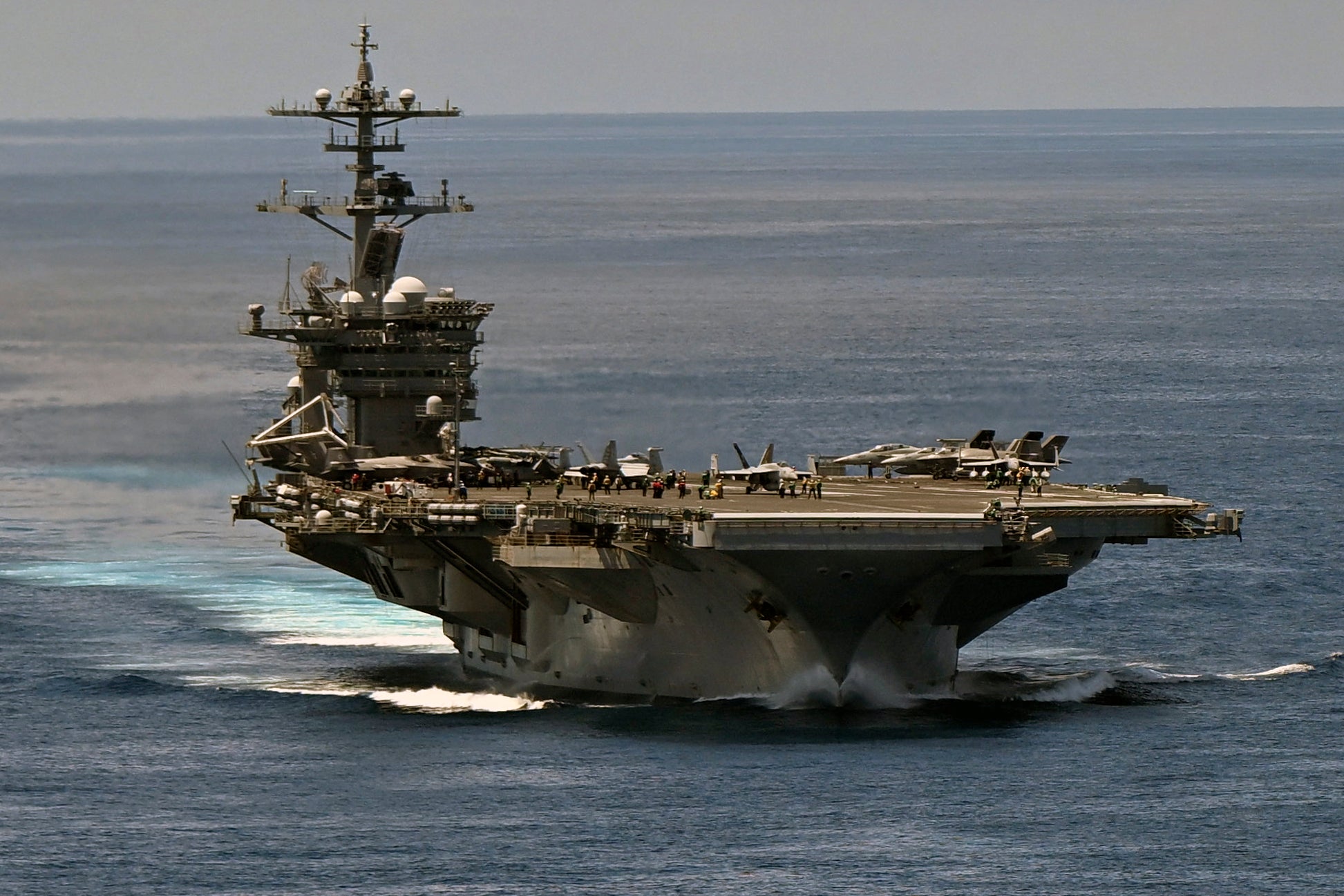
Officials have indicated to Reuters that the USS George Washington, currently in Asia, and the USS George H.W. Bush, on the U.S. east coast, are the most probable candidates, though each is at least a week away from the Middle East. The Pentagon could also opt to deploy the Ford carrier from the Caribbean.
“After the talks, we felt there was understanding and consensus to continue the diplomatic process,” stated Esmaeil Baghaei, the Iranian foreign ministry spokesman. Baghaei confirmed that Tuesday’s visit to Oman by Ali Larijani, an adviser to Supreme Leader Ayatollah Ali Khamenei, had been pre-planned, and that Larijani would subsequently travel to Qatar, another nation that has mediated in several Middle East crises.
Oil prices saw a slight ease on Tuesday as traders remained focused on the evolving Iran-U.S. tensions. A Reuters analysis of satellite images revealed a recent build-up of aircraft and other military equipment across the region.
Notably, U.S. forces at Qatar’s al-Udeid, the largest U.S. base in the Middle East, have been observed placing missiles into truck launchers as tensions with Iran have escalated since January, enabling quicker deployment if necessary.
Oman’s state news agency reported that Larijani and Omani Sultan Haitham bin Tariq discussed avenues to achieve a “balanced and just” agreement between Iran and the U.S., emphasising the importance of returning to dialogue to bridge differences and foster regional and global peace and security. The U.S. is seeking to broaden the scope of negotiations with Iran beyond the nuclear issue to include curbing Iran’s ballistic missile programme, one of the largest in the Middle East. Tehran maintains that its missile arsenal has been rebuilt since last year’s 12-day bombing campaign by Israel and the U.S., and that its stockpile is non-negotiable. Israeli Prime Minister Benjamin Netanyahu is expected to leverage a meeting with Trump in Washington on Wednesday to advocate for any U.S.-Iran deal to incorporate limitations on Tehran’s missiles.
Baghaei asserted that the U.S. “must act independently of foreign pressures, especially Israeli pressures that ignore the interests of the region and even the U.S.” In any negotiations, Iran would continue to demand the lifting of financial sanctions and insist on its nuclear rights, including enrichment, Iranian President Masoud Pezeshkian has stated.
Washington has demanded that Iran relinquish its stockpile of uranium enriched to up to 60% fissile purity, a small step away from the 90% considered weapons grade.
The head of Iran’s Atomic Energy Organisation, Mohammad Eslami, said on Monday: “The possibility of diluting 60% enriched uranium … depends on whether, in return, all sanctions are lifted or not.”
Asked whether the U.S. would permit limited uranium enrichment by Iran, U.S. Vice President JD Vance said during a visit to Armenia on Monday: “I think President Trump is going to make the ultimate determination about where we draw the red lines in the negotiations.” Iran and the U.S. held five rounds of talks last year on curbing Tehran’s nuclear programme, with the process ultimately breaking down primarily due to disputes over uranium enrichment within Iran. Since Trump struck Iran’s facilities, Tehran has stated it has halted enrichment activity, consistently maintaining that its nuclear programme is solely for peaceful purposes.
Source: independent.co.uk
