

Bernie Sanders-Backed Progressive Triumphs In New Jersey Primary
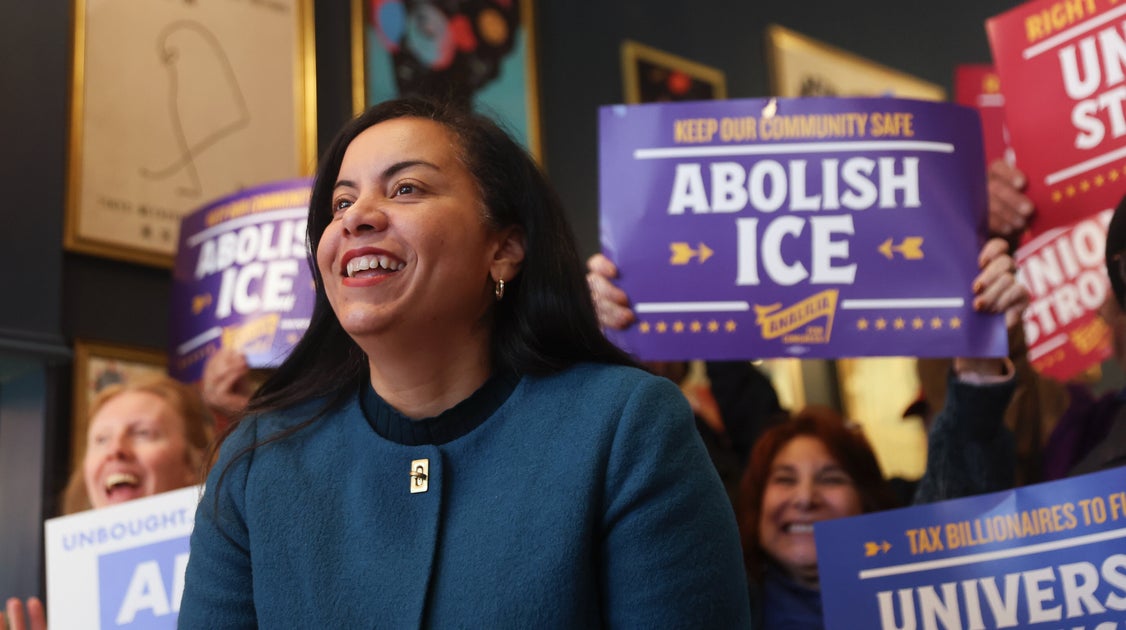
Progressive activist Analilia Mejia won the Democratic primary in a special election to represent the New Jersey suburbs in Congress, a significant win for the left in the ongoing battles over the party’s ideological direction and a massive own goal by pro-Israel groups who attacked the front-runner in the race.
Her victory became official when former Rep. Tom Malinowski, who had been trailing Mejia by less than a thousand votes since election night, conceded on Tuesday morning.
Advertisement
Mejia campaigned with Sen. Bernie Sanders (I-Vt.) and Rep. Alexandria Ocasio-Cortez (D-N.Y.), and had the backing of a host of other left-wing groups and figures. A former political director for Sanders’ presidential campaign and leader of the progressive Center for Popular Democracy, Mejia began the race with significantly less name identification than her opponents, but benefited from both high-profile endorsements and from Democrats’ increased opposition to U.S. Immigration and Customs Enforcement, an agency she supports abolishing.
“Traditional politics and the same ol’ blue is not going to be effective in confronting MAGA Trumpism and a corrupt administration,” she said in an interview earlier this week. “I wanted a different voice for myself, and I know that my friends and neighbors in the district did too.”
What makes Mejia’s win remarkable is both whom she beat and where she won. She not only defeated the race’s front-runner, former Rep. Tom Malinowski, but also the preferred candidate of New Jersey’s once-feared political machine, Essex County Councilmember Brendan Gill, and former Lt. Gov. Tahesha Way, who received millions of dollars of outside support and was the preferred candidate of pro-Israel groups.
Advertisement
And the 11th District, which was previously held by moderate Gov. Mikie Sherrill and consists of suburbs in northern and central New Jersey, is not like most other districts represented by progressives. It’s highly educated, majority white, wealthy and far less Democratic than the urban districts represented by the likes of Ocasio-Cortez, Rep. Ilhan Omar (D-Minn.) and Rep. Ayanna Pressley (D-Mass.)
While the race served as a preview to the upcoming Democratic primary season, elements of Mejia’s win may be difficult for the left to replicate elsewhere. The divided field ― there were four candidates seen as truly competitive, plus a handful more who waged real campaigns ― allowed Mejia to win with roughly 30% of the vote. And in many races, a candidate with Mejia’s ideological profile will suffer from heavy outside spending rather than benefit from it.
The decision by United Democracy Project, an AIPAC-linked super PAC, to spend $3 million attacking Malinowski over his support for putting conditions on aid to Israel, however, clearly backfired here. The super PAC’s ads targeted Malinowski for voting to fund ICE during an earlier stint in Congress, which ultimately benefited Mejia, who takes a more critical line on Israel ― she’s called the assault on Gaza a “genocide” ― than the former congressman.
Advertisement
Mejia is a strong favorite to win the general election in the race in April, but will have to run in another Democratic primary in June and win another general election in November to earn a full term. While Malinowski and Gill both said they would not run for a full term if they lost the special election, Way has not.
In a statement, United Democracy Project indicated both that it was aware of the risk it took in attacking Malinowski and that it could get involved in the June primary to stop Mejia from winning a full term.
“The outcome in NJ-11 was an anticipated possibility, and our focus remains on who will serve the next full term in Congress,” the group said. “UDP will be closely monitoring dozens of primary races, including the June NJ-11 primary, to help ensure pro-Israel candidates are elected to Congress.”
Advertisement
