

Democrats Dig In Heels On ICE Demands As Funding Deadline Nears
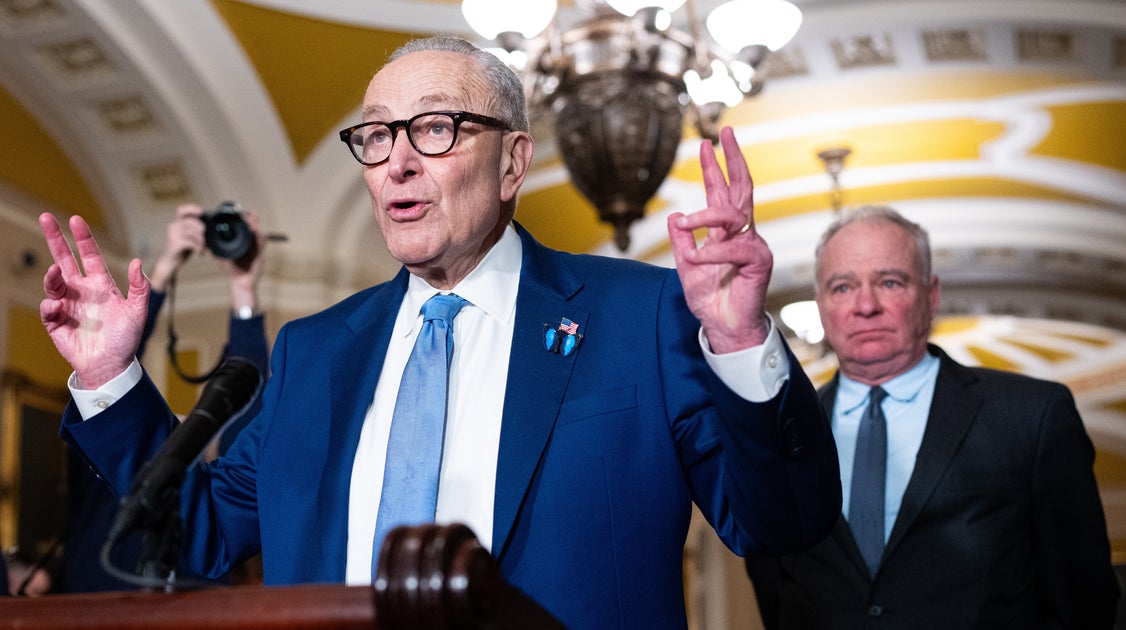
WASHINGTON ― Congressional Democrats are holding firm in their demands for immigration enforcement reform in legislation funding the Department of Homeland Security, setting up a likely shutdown of the agency barring a last-minute deal before a Friday deadline.
Congressional Democratic leadership and President Donald Trump’s White House traded competing proposals for reforming Immigrations and Customs Enforcement tactics that led to the deaths of two American citizens in Minnesota last month, but Democrats maintain Republicans are still not being serious about enacting real accountability and reforms.
Advertisement
House Democratic leader Hakeem Jeffries (D-N.Y.) told HuffPost on Tuesday the White House opposes requiring ICE or Border Patrol agents to get judicial warrants for raids on homes or allowing independent investigations of officers’ conduct — two of 10 Democratic demands for voting to fund DHS.
“And they’re not open to the type of training that is needed in order to ensure that taxpayer dollars are not being used to brutalize American citizens or, in some cases, kill them,” Jeffries said.
Jeffries said it was more of an “open question” whether Trump and his team would consider disallowing ICE agents from wearing masks. Still, he didn’t sound optimistic.
Advertisement
“They don’t appear to be open to masks either or necessarily ensuring that ICE agents are identifiable in a manner consistent with every other law enforcement agency in the country,” Jeffries said.
Senate Democrats demanded DHS funding be separated from a broader government funding bill that passed last month, setting up the Friday deadline. Now, with negotiations making little progress, many Democratic senators are threatening to block the DHS funding bill if they don’t get their way. Doing so would do little to slow down ICE ― which has its own funding stream set up by the GOP budget law passed last year ― and could potentially lead to a shutdown of the Federal Emergency Management Agency and Transportation Security Administration.
Sen. Angus King, an independent who caucuses with Democrats, said he didn’t know anybody in the Democratic caucus who would vote for another short-term extension of DHS funding to give the negotiations more time “unless there are serious reforms to ICE.” King was among the Democratic allies who broke with the party to end a full government shutdown in November.
Advertisement
“They don’t seem interested in trading actual offers,” Sen. Chris Murphy (D-Conn.) added of the GOP negotiators. “I just think they may be betting that the public’s attention is going to move somewhere else. I think that’s a bad bet. I think people are on our side.”
When asked by a reporter if Democrats will block a short-term funding extension, Senate Minority Leader Chuck Schumer (D-N.Y.) also did not explicitly rule out the possibility.
“There’s no reason we can’t get this done by Thursday,” he said at a press conference.
The DHS funding bill includes $10 billion for ICE as well as billions of dollars for other federal agencies, including the Coast Guard, TSA and FEMA. Republicans warned the blame would fall on Democrats if those agencies experience a funding lapse.
Advertisement
“A government shutdown ― even one that affects just one agency ― is not in anybody’s interest, least of all that of the hardworking Americans who staff these agencies and the American people who depend on their important work,” Senate Majority Leader John Thune (R-S.D.) warned on Tuesday.
The White House said it was continuing to engage with Democrats about ICE amid a public backlash over the violence in Minnesota, a sharp break from its behavior during the November shutdown, when Trump avoided negotiations. The shutdown coincided with a drop in Trump’s approval rating.
“We are continuing to have constructive conversations with members of both parties,” a White House official told HuffPost. “President Trump wants the government to remain open and for critical services to remain funded.”
Advertisement
The heads of ICE and Border Patrol, meanwhile, testified at a hearing of the House Homeland Security Committee, where the panel’s Republican chairman, Rep. Andrew Garbarino of New York, acknowledged immigration enforcement is at an “inflection point” with an opportunity to restore public trust.
Todd Lyons, the acting director of ICE, was defiant, complaining ICE personnel have faced excessive threats for doing their jobs. He and Border Patrol director Rodney Scott said their agents are adequately trained for dealing with protests ― both of the people fatally shot in Minnesota were activists monitoring immigration officers. Lyons acknowledged new ICE recruits have a shorter training regimen than longer-tenured officers, but he said they still go through the same curriculum.
Lyons bristled at agents being likened to Nazi Germany’s secret police. And in response to a question from Rep. Eric Swalwell (D-Calif.), Lyons declined to apologize to the families of Rene Good and Alex Pretti, who were killed while protesting the immigration crackdown in Minnesota and were then called “terrorists” by senior members of the Trump administration.
Advertisement
“I’m not going to comment on the investigation, and the president and Secretary Noem are elected officials,” Lyons said.
Garbarino told HuffPost he thought the hearing could help the negotiations.
“The answers that we got today from the head of ICE and CBP cleared up a lot of confusion as to training and how officers are armed,” Garbarino said. “So I think it did a lot to calm the public and calm members down with getting us more information.”
But Schumer disagreed, saying there has been no meaningful change to the situation on the ground in Minneapolis.
Advertisement
“Thousands of agents are still roaming the streets, people are still being assaulted by federal law enforcement, and it’s only a matter of time before someone else gets seriously hurt or God forbid killed,” Schumer said in a floor speech. “If the heads of ICE and Border Patrol are genuine about lowering the temperature, they should tell Congress that the only real answer is commonsense bipartisan legislation. Nothing else will suffice.”
