

Thousands in Moldova minimize off from water after Russian strike pollutes river
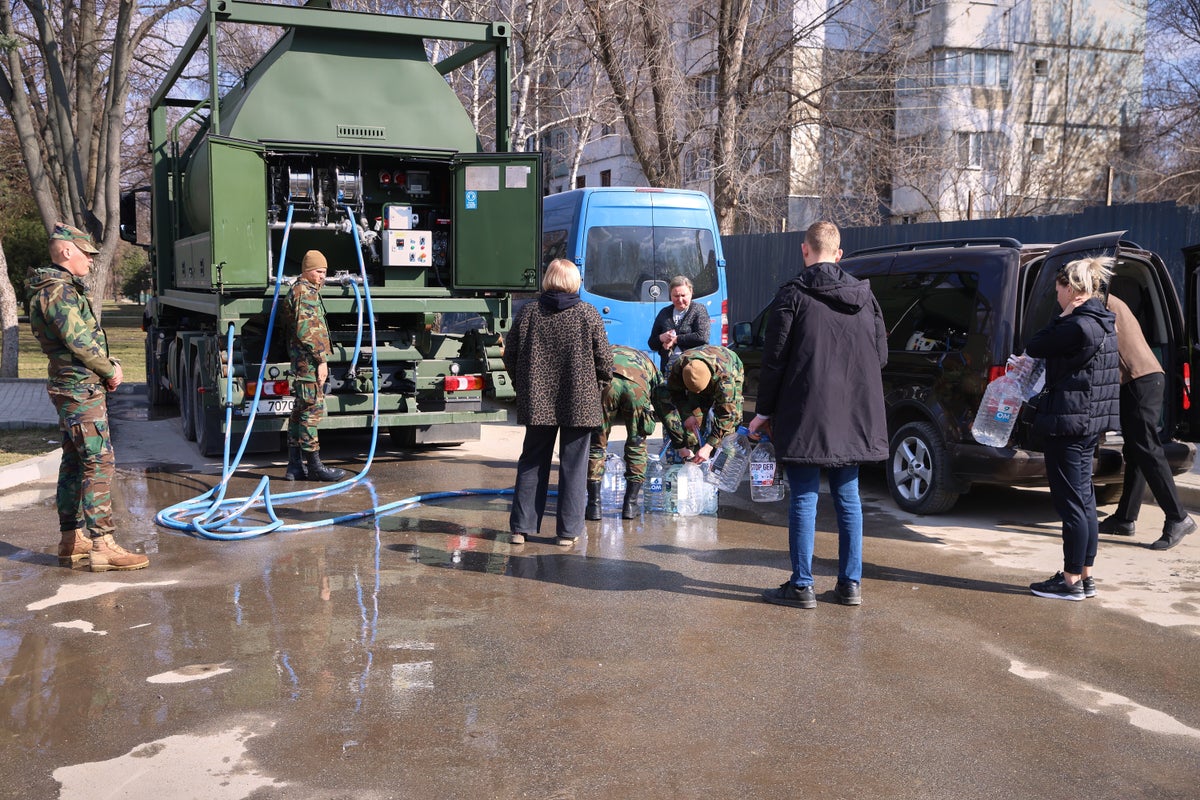
Tens of thousands of Moldovans have been left without water after a Russian strike on a Ukrainian hydroelectric plant resulted in oil polluting a major river that flows through both countries. The Dniester River was contaminated following an attack on Ukraine’s Novodnistrovsk hydropower plant on March 7.
Moldovan President Maia Sandu has directly blamed Russia for the pollution, stating it is “threatening Moldova’s water supply” in the European Union candidate country.
The Ukrainian facility is situated approximately 15 kilometres (9 miles) upstream from Moldova’s northern border and is vital, supplying water to about 80 per cent of Moldova’s 2.5 million residents. This incident aligns with Moscow’s repeated targeting of Ukraine’s civilian infrastructure, such as dams and river ports, since its full-scale invasion in 2022.
“Russia bears full responsibility,” Sandu said on Sunday in a post on X.
Moldova’s environment ministry on Sunday declared an environmental state of alert for 15 days, giving the authorities a legal mechanism to boost technical interventions and impose temporary restrictions on water supplies.
“We are taking this decision to make sure we prevent any risk to the population’s health,” it said. “Because of the continuous wave of pollution with oil products, the risk of the pollution spreading, and the exceedance of contaminant levels in the northern area of the Dniester River.”
While oil pollutants have been confirmed in the river following the strike, the exact source of the pollutant is not yet clear.
The situation has forced the authorities to cut the water supply to several districts, including Moldova’s second-largest city of Balti, which has a population of about 90,000 people. As well as humanitarian aid from neighboring Romania, Moldova’s military stepped in this week to distribute drinking water in the northern city from a 10-tonne tanker.
“It’s very hard, very hard,” said 84-year-old Balti resident Liuba Istrati, who has been carrying buckets of water up to her apartment. “We live on the fifth floor, it’s just the two of us, old people, my husband is sick in bed.”
The water shortage has also forced some schools to close and move learning online.
“It’s a complicated situation, I have to come every day to get water,” said Irina Mutluc, a teacher living in Balti. “Even for one person you need quite an amount of water to consume, for the bathroom and so on, so it’s really complicated.”
The authorities are now racing to clean up pollution and analyze and monitor the river water. Neighboring Romania, which has close relations with Moldova, has dispatched teams and equipment, such as absorbent materials for dams, to aid cleanup efforts.
“The latest samples taken show an improvement in the water indicators, which confirms the effectiveness of the filters and barriers for the capture and disposal of pollutants,” the Ministry of Environment said on Wednesday.
The ministry added that the authorities are “working at an accelerated pace” to resume water supplies, “but this decision will be made exclusively on the basis of at least two consecutive sets of analyses, taken on two different days … Protecting the health of citizens remains the absolute priority.”
Moldova’s environment minister Gheorghe Hajder said Wednesday at a press briefing that for the first time since the crisis began, three critical monitoring points on the river “reached the admissible limit” of oil pollution.
He added that if the analyses show the same results or improve in the next 48 hours, authorities will consider reopening a pumping station on the northeastern border with Ukraine, which supplies several districts and Balti.
“It is clear evidence that upstream oil diversions have been greatly mitigated, and the absorbing dams have had their effect,” he said.
The Dniester River originates in southwestern Ukraine and spans more than 1,300 kilometers (846 miles), continuing downstream through Moldova, back through southern Ukraine and empties into the Black Sea.
“Although at some points values may temporarily return within acceptable limits, matter continues to come in waves, making it difficult to accurately anticipate evolution,” the environment ministry said.
Moldova’s General Prosecutor’s Office said Tuesday that it will open a criminal case to investigate the matter, while Moldova’s foreign ministry summoned Russia’s ambassador to Chisinau, Oleg Ozerov, who was presented with a bottle of brownish water.
In an online statement on Wednesday, the Russian embassy in Moldova argued that the Moldovan authorities have not presented any evidence of Russia’s complicity, aside from “a container with an unknown murky liquid, with no markings regarding where and when it was obtained,” and that “by definition cannot be proof of anything.”
The statement claimed that Moldovan authorities “publicly claim a lack of precise information about the nature of the incident, the type, and the amount of pollutants,” putting forward “conflicting theories.”
Ilya Trombitsky, a biologist at Eco-TIRAS, an umbrella of nongovernmental organizations in Moldova and Ukraine, says that while it’s difficult yet to determine the short or long-term consequences of the pollution, the fact that “several cities are without water is an evident social damage.”
“It depends on the nature of the pollutant … we still do not know either the source or the substance of pollution,” he told The Associated Press. “It is evident that it is not healthy for birds, wetland birds. It is evident that some invertebrates were killed, especially upstream … crustaceans, but small ones, (which) can be food for fish.”
“Moldova does not have experience in such spills,” he added.
Source: independent.co.uk
