

Bush hails his former VP Dick Cheney as ‘devoted to protecting the interests of the US’ at funeral the place Trump and Vance weren’t invited
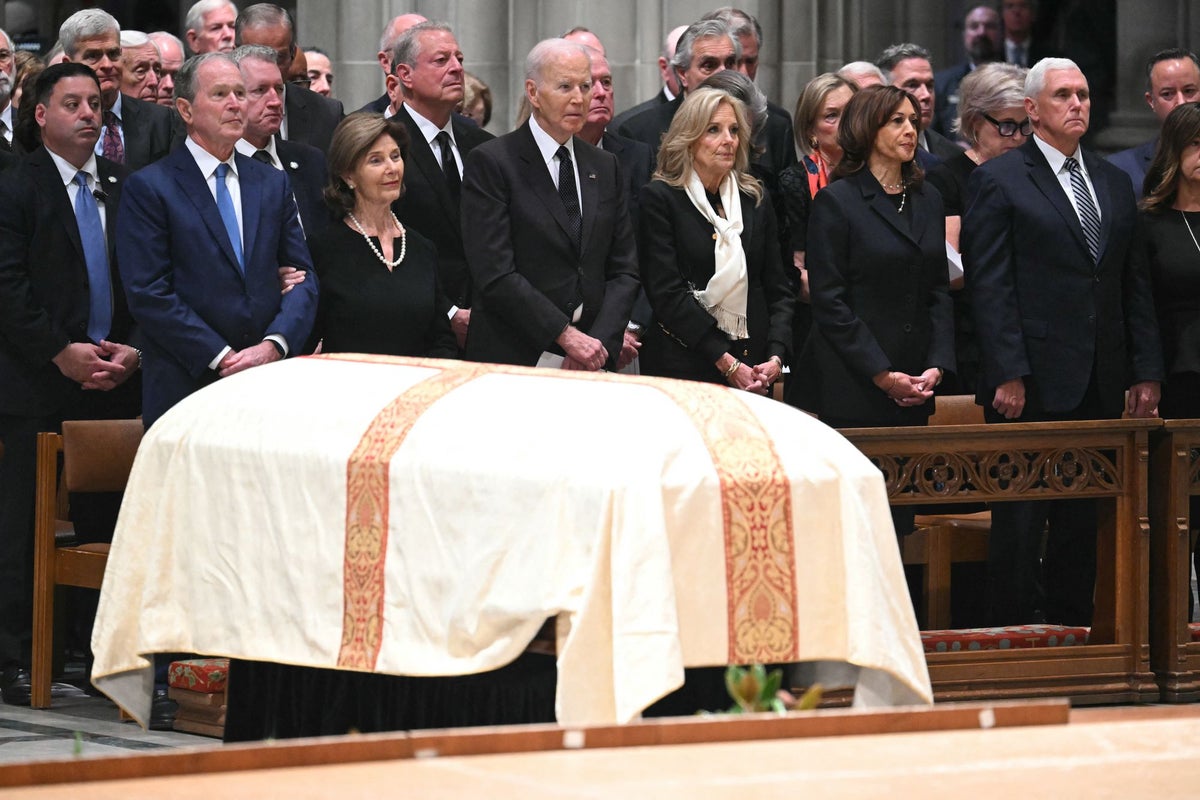
The funeral for former Vice President Dick Cheney is being held in Washington, D.C., with former presidents and vice presidents attending – but not President Trump and Vice President JD Vance.
While sitting presidents typically attend the funerals of former presidents and vice presidents, Trump and Vance were not invited to attend the memorial service, a source told CNN.
Cheney, who served under former President George W. Bush from 2001 to 2009, is largely credited with becoming one of the most influential – and controversial – vice presidents in modern American history.
The procession of Cheney’s flag-draped casket began at 11 a.m., with his family following behind the casket. More than 1,000 guests were expected at the invitation-only funeral held at Washington National Cathedral, including all four living former vice presidents and two former presidents.
Former presidents George W. Bush and Joe Biden are attending, along with former first ladies Laura Bush and Jill Biden. Next to them were former vice presidents Kamala Harris and Mike Pence, with Al Gore and Dan Quayle in the row behind them.
Also expected to attend were several Supreme Court justices, past and present, cabinet members from both Republican and Democratic administrations and congressional leaders from both major parties.
Former President Bush remembered Cheney as “a vice president totally devoted to protecting the United States and its interests.”
He recalled that Cheney had been helping him choose a running mate when he “realized the best choice for the vice president was the man sitting in front of me.”
Cheney’s daughter, former Wyoming Rep. Liz Cheney said her father decided to take up public service after hearing former President John F. Kennedy, a Democrat, urging students to do so.
“Dick Cheney became a Republican, but he knew that bonds of party must always yield to the single bond we share as Americans,” she said.
Tributes were also given by several of Cheney’s grandchildren, his longtime cardiologist, Jonathan Reiner and former NBC News correspondent Pete Williams, who was Cheney’s spokesman at the Pentagon.
Cheney, whose political career spanned five decades, died earlier this month from complications related to pneumonia and cardiac and vascular disease, which he battled most of his adult life. He was 84.
In addition to serving as Bush’s vice president, Cheney was also the defense secretary for President George H.W. Bush and chief of staff for President Gerald Ford. He also served 10 years as Wyoming’s sole representative to the House, a job his daughter, Liz, later took on.
While Cheney was a longtime conservative who endorsed Trump’s 2016 campaign, he spent the final years of his life speaking out against the current administration.
Cheney and his daughter, Liz, became regular targets of Trump during his most recent re-election campaign due to their fierce criticism of the then-former-president. His daughter had long been a target of Trump’s after holding a prominent role in the congressional committee investigating the January 6, 2021, attack on the U.S. Capitol.
Despite rarely appearing in public during his later years, Cheney appeared in a political advertisement for his daughter in 2022 to denounce Trump.
“In our nation’s 246-year history, there has never been an individual who is a greater threat to our republic than Donald Trump,” Cheney said, calling the now-president a “coward.”
“A real man wouldn’t lie to his supporters. He lost his election, and he lost big. I know it. He knows it, and deep down, I think most Republicans know,” Cheney said in the advertisement.
According to his daughter, Cheney endorsed former Vice President Kamala Harris ahead of the 2024 presidential election.
Meanwhile, the current president, Trump, said little about Cheney following his death on November 3. Trump never made a statement about Cheney’s death and did not issue a presidential proclamation, which generally follows the death of notable figures.
After Cheney’s death, the White House lowered its flags to half-staff, which press secretary Karoline Leavitt said was “in accordance with statutory law.”
Cheney was considered by many to be one of the most influential vice presidents in recent history, although some of his policies proved highly controversial, especially in the wake of the September 11 terror attacks on the U.S. in 2001.
He was seen as one of the architects of the War on Terror, which included the invasion of Afghanistan in 2001, the invasion of Iraq in 2003, the implementation of the Patriot Act – which extended the government’s surveillance powers – and the use of “enhanced interrogation” techniques, condemned as torture by critics, against terror suspects.
Earlier in his career, as defense secretary in 1991, he helped plan U.S. involvement in the First Gulf War, following Iraqi dictator Saddam Hussein’s invasion of Kuwait.
The 2003 invasion of Iraq in particular proved a catalyst for fierce opposition both in the United States and around the world. President Bush’s administration and its allies were accused of building a false pretext for invasion by claiming that Saddam was developing weapons of mass destruction and that he may be linked to Al-Qaeda, the terrorist group behind the 9/11 attacks.
The war saw thousands of combatants and civilians killed and wounded and was blamed for devastating the region and eventually leading to the rise of the Islamic State terror group.
Cheney later stood by the decision to invade Iraq, telling the Senate Intelligence Committee in 2014: “I would do it again in a minute.”
He is survived by his wife, Lynne; his daughters, Liz and Mary; and seven grandchildren.
Source: independent.co.uk
