

Trump And Republicans Are Doing Everything They Can To Shrug Off A Crisis
This article is part of HuffPost’s biweekly politics newsletter. Click here to subscribe.
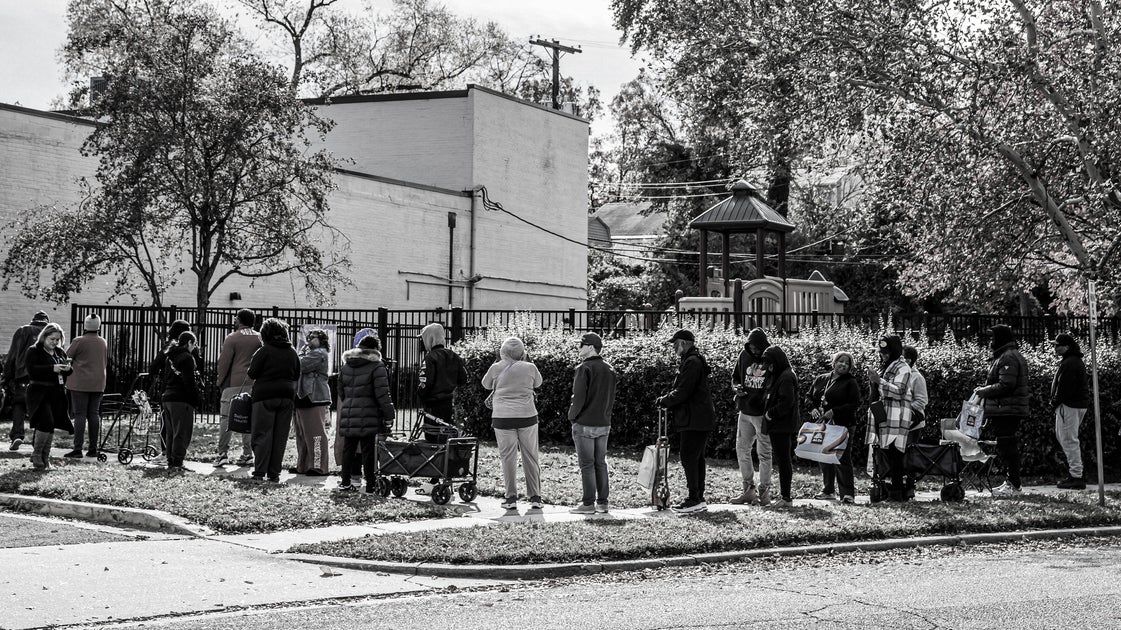
As the federal government shutdown drags on, the hunger crisis is growing. More than 1 million federal workers are once again going without a paycheck, while 42 million people didn’t receive their food benefits at the start of the month. Grocery prices continue to climb while lines at food pantries are growing. And food banks are straining under the weight of growing need and shrinking budgets.
The country is now facing the perfect storm for a hunger emergency. But President Donald Trump, a billionaire, is sick of hearing about hungry people.
Advertisement
“I don’t want to hear about the affordability, because right now we’re much less,” he said in his signature confusing word salad at a press conference on Thursday. “Our groceries are way down. Everything is way down, and the press doesn’t report it.”
He doubled down on Friday, telling reporters, “the reason I don’t want to talk about affordability is because everybody knows it’s far less expensive under Trump than it was under Sleepy Joe Biden and the prices are way down.”
Trump won the presidential election last year in part by promising to bring down grocery prices. Instead, he has helped fuel a hunger crisis that shows no sign of abating.
Advertisement
“We started getting a lot of calls from people who’ve never accessed food assistance,” Cyndi Kirkhart, the CEO of Facing Hunger food bank based in Huntington, West Virginia, told HuffPost. Kirkhart said the food pantries in her network, during a really busy month, might have 50 different households show up for assistance.
“Two weeks ago, we had 25 families [in one day] show up here at the food bank and get an emergency food box,” she said — and the numbers are only increasing.
This story is being replicated across the country.
“We’re seeing more people and we’re distributing more food,” Celia Cole, the CEO of Feeding Texas, a network of food banks in the state, told HuffPost. “We’re seeing people who woke up last Saturday and they didn’t have any [food] benefits loaded onto their card.”
Advertisement
“[Food] is the first thing that people sacrifice in order to make ends meet,” Michael Halligan, the CEO of God’s Food Pantry in Kentucky, also told HuffPost.
“And we’re seeing more people reaching out for food they need.” Across the food bank’s network of 500 different pantries, the number of people looking for help has increased from anywhere between 56% to 200% in the last few weeks.
The surge of people who now need help feeding their families is taking a toll on the people who staff the assistance centers. “There’s pressure on the food banks,” Kirkhart said. ”We all look like we’ve been on the battleground.”
Advertisement
The influx of people who need food means that lines are long and food distribution centers are filled with families.
“This is like the pandemic on steroids. In the 11 years I’ve been here, it’s never been like this,” Kirkhart said. “We’re seeing families with children who are waiting in long lines, their children are hungry and crying.”
None of this was unavoidable. In fact, the increasingly dire state of hunger in the United States can, by many metrics, be blamed on Trump.
Advertisement
The government shutdown has been part of it. Congress’ inability to agree to a federal budget last month led to a lapse in federal spending and the furlough of hundreds of thousands of employees starting on Oct. 1. Other federal employees, like air traffic controllers, are working without pay, and are about to get their second $0 paycheck. Secretary of Transportation Sean Duffy has stressed the financial pressure on Federal Aviation Administration employees. “A lot of us can navigate missing one paycheck. Not everybody, but a lot of us can,” Duffy said air traffic controllers have told him. “None of us can manage missing two paychecks.”
Trump hasn’t done much to try to end the shutdown, recently spending a weekend in Florida to golf.
Many recipients of Supplemental Nutritional Assistance Program, colloquially known as food stamps, as of Friday morning have yet to receive their November benefits due to the shutdown — and it’s unclear when they will and how much they’ll actually get.
The Trump administration is playing politics with SNAP benefits, leaving states and recipients in the dark. First, the U.S. Department of Agriculture announced that the funds would run dry on Nov. 1 and the agency would not be using contingency funds. Following a court order, the USDA said it would pay at least partial benefits. Trump, too, seemingly changed his mind, saying SNAP benefits would go out, but then changed his mind again on Tuesday morning, posting on social media that they wouldn’t.
Advertisement
Even more confusion came on Friday afternoon, when USDA said it would in fact pay SNAP benefits in full for November. No mention was made of what would happen in December.
Add to the whiplash of the back-and-forth the fact that despite Trump’s campaign rhetoric, groceries have gotten more expensive: Trump imposing broad tariffs on imported goods, including food, coupled with his unprecedented crackdown on undocumented immigrants who make up a large part of the farm workforce, has meant that the cost of items like meat, dairy products and produce have increased.
In the meantime, food banks, a lifeline of last resort for many, have been straining under the weight of the Trump-fueled hunger crisis. While they’re ramping up efforts to feed people and get them the help they need, it’s not enough.
Advertisement
“SNAP operates at a scale that food banks can’t make up for,” Cole said. “In the first week alone [without SNAP], it’s had a significant impact.”
She also warned that getting only some SNAP funds doesn’t adequately solve the problem. “When partial benefits go out, it still won’t be enough.”
Food banks have been a major victim of the Trump administration’s funding cut spree. In March, the federal government cut two Biden-era programs that provided funds to communities and food banks to buy fresh and healthy food directly from local farmers.
Advertisement
Feeding Texas and Facing Hunger in West Virginia lost millions of crucial dollars needed to feed hungry people in their communities.
The total amount of cuts totaled $1 billion across the country, leaving food banks with substantially fewer resources than they were planning on having.
Then, there’s the so-called One Big Beautiful Bill. It not only cuts $300 billion from SNAP through 2034, but the massive piece of legislation also ends SNAP-ED, a free nutrition education program that gives money to food banks so they can teach SNAP recipients how to make their benefits last longer and how to purchase the most nutritious foods.
Advertisement
As the longest government shutdown in history enters its sixth week, even federal workers, who usually have stable incomes, are turning to food pantries for help too.
In the Washington, D.C., region, charities reported being “overwhelmed” by how many people showed up to events specifically for furloughed workers in October. “I didn’t think we were going to have this many federal employees,” one event organizer told CNN.
Despite Republicans’ attempt to blame the SNAP snafu on Democrats, polling shows that it is largely the GOP taking the blame. Even Trump acknowledged this after huge losses for the GOP in this week’s elections. “I think if you read the pollsters, the shutdown was a big factor, negative for the Republicans,” he said at a Republican breakfast on Wednesday.
Advertisement
And now, Trump and the Republicans are seemingly doing everything they can to shrug the problem off, blame people for daring to need food, and arguing in court that they shouldn’t even have to make sure the poorest among us are able to get food.
Speaker of the House Mike Johnson (R-La.) shrugged off the food crisis. “All of the economists have shown that food prices always go up,” he said when asked about increasing grocery prices that have been straining household budgets. “There’s an inflationary level that’s built in to grocery prices.”
Trump, who threw a lavish, Great Gatsby-themed Halloween party right before food benefits were set to run out, painted SNAP recipients as freeloaders. “It wasn’t meant for people that could do whatever they want.” he said on Thursday, “the people that say, ‘Well, I don’t think I’ll work. I’ll just collect this money.’”
Advertisement
It doesn’t sound like the GOP even wants hungry people to get food. On Friday, just a few hours before the USDA committed to paying SNAP, the Trump administration asked a federal court to block an order that requires it to pay out benefits.
Vice President JD Vance was indignant at the thought of a federal judge forcing the government to give out food benefits. “It’s an absurd ruling,” he said about the judge who ordered the Trump administration to use contingency funds to pay out benefits. “In the midst of a shutdown, we can’t have a federal court telling the president how he has to triage the situation.”
Even more grotesque, while SNAP benefits hung in the balance, the White House on Thursday held an event announcing a new deal that would lower the costs of popular weight loss drugs. “Americans will lose 135 billion pounds by the midterms,” Mehmet Oz, the administrator of the Centers for Medicare and Medicaid Services, bragged. (That number would require every American to lose 400 pounds by next November.)
Advertisement
A member of the administration touting weight loss drugs while millions of people aren’t sure where their next meal is coming from is, perhaps, the perfect encapsulation of how seriously Trump is taking this latest crisis.
